Hotel Amenities: Should You Choose Disposable or Durable?

Categories : All Posts
star
star
star
star
star

Faced with the mandatory transition toward CSR, many purchasing and financial directors in the hospitality sector believe that switching to sustainable products will inevitably weigh down their operational margins. Historically, the accommodation industry has relied on a single-use model for hotel equipment, favoring a low upfront catalog price. However, this "cheap to buy" strategy often hides an invisible financial abyss, diluted across various operational expense lines.

Today, the real issue is no longer the facial price of an item, but its TCO (Total Cost of Ownership). What is the true cost of a disposable plastic slipper compared to a durable, bio-sourced alternative when analyzed over an entire season?

Through a strategic and mathematical demonstration, this article proves that ecology is now the most powerful profitability lever for your establishment. For more in-depth insights, you can read our complete guide on how to choose hotel slippers.

1. The "Unit Cost" Trap: The Hidden Expenses of Low-End Disposables

The traditional approach to hotel purchasing involves negotiating the unit cost of consumables. Classic plastic flip-flops or economic slippers bought for a few cents seem like a great deal to equip a spa. This is a financial illusion.

The ultra-fast turnover rate

In a humid environment like a spa, an entry-level disposable flip-flop reveals its structural weaknesses within hours. The strap tears off, the sole compresses. The guest asks the staff for a new pair. A product designed for ephemeral use often lasts only a single day.

The invisible logistics

This continuous replacement generates massive hidden costs. Housekeeping spends considerable time restocking carts with courtesy accessories, distributing new pairs, and collecting defective products. Storing thousands of disposable pairs monopolizes precious square footage. Finally, waste management taxation is sharply increasing.

The cost of markdown and waste

It is not uncommon to throw away standard hotel slippers that have barely been worn for ten minutes by a guest, simply to comply with hygiene protocols. This perpetual waste heavily impacts profitability.

2. The Mathematical Demonstration: ROI Simulation Over a Season

To ground this analysis, let's consider an 80-room hotel-spa operating over a 100-day summer season.

Assumptions: An 80% occupancy rate (64 occupied rooms per day, 128 daily guests). Average stay length is 4 nights. Total: 3,200 guest stays over the season.

Analysis Criterion
Disposable Option (Basic petrochemical EVA)
Durable Option (E.g., Merveyl bio-sourced range)
Guest Behavior
Frequent breakage, estimated 1 pair/day
Optimal resistance, 1 pair for the whole stay
Required Volume
128 guests x 100 days = 12,800 pairs
3,200 guests (1 pair/stay) = 3,200 pairs
Unit Purchase Price
0.80 €
1.80 €
Total Purchase Cost
10,240 €
5,760 €
Volume of Waste
Approx. 12,800 pairs to process & pay for
Close to 0 (guests take the product home)

The financial verdict:

Although the durable option, much like our ecological slippers, is initially more expensive, the drastic drop in consumption volume generates a net saving of 4,480 € in a single season.

3. Innovation Focus: "I'm Green™" Technology as a Performance Driver

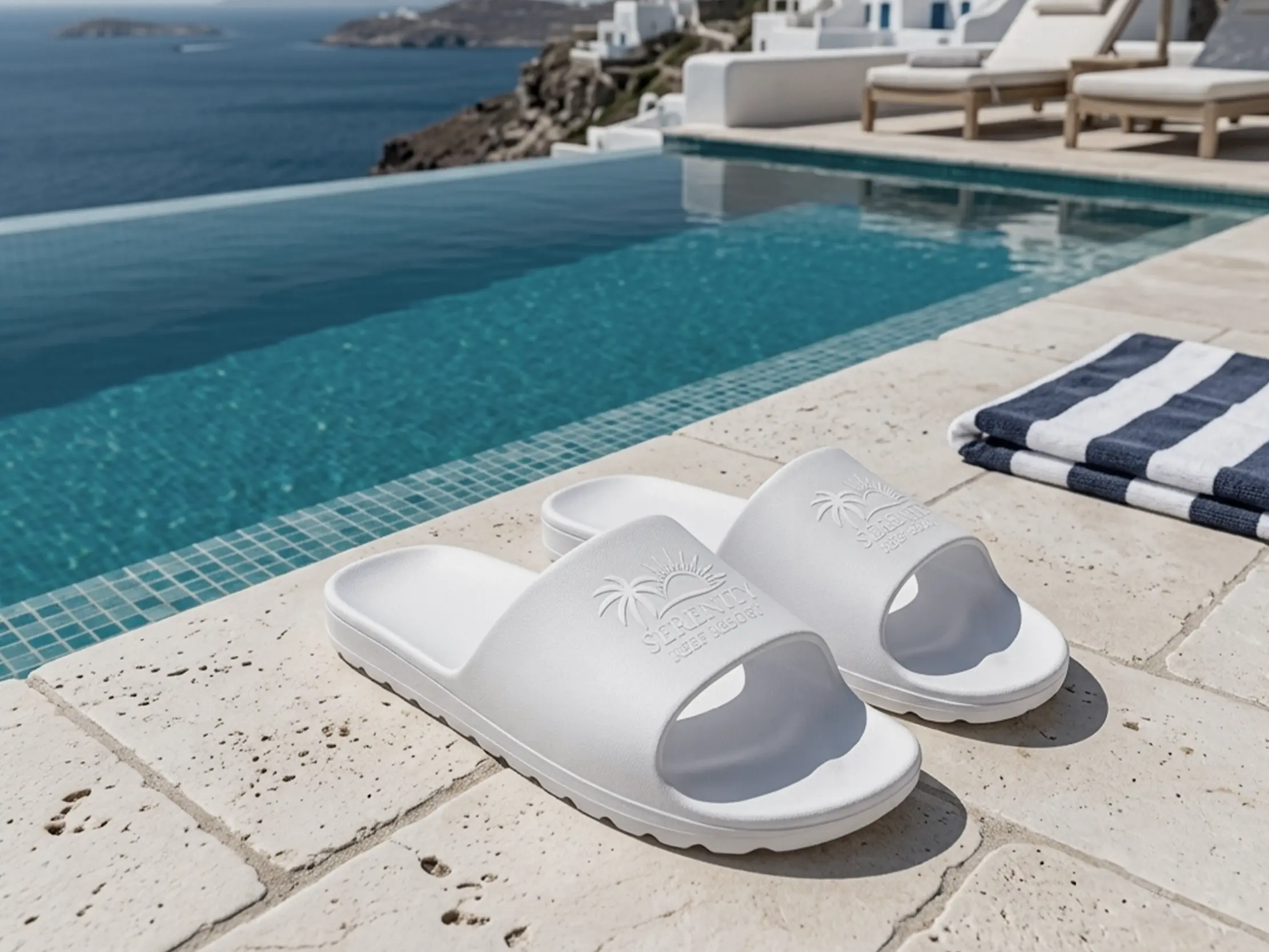
This economic pivot is made possible by a specific technological transition. Merveyl has chosen to break away from planned obsolescence by offering a world exclusivity: one-piece molded flip-flops and sandals featuring I'm Green technology.

The exclusivity of the monobloc design

Unlike classic models where the strap is glued into the sole, our I'm Green flip-flops and sandals are injected as a single block. This architecture completely eliminates the risk of breakage.

Bio-sourced materials for longevity

The material used is a bio-sourced polyethylene made from sugarcane. It allows the sandals to be machine washed at 30°C. They accompany the guest throughout their stay, acting as genuine luxury slippers. As an alternative, we also provide 100% compostable slippers.

Discover these innovative products by visiting our page for bio-sourced flat flip-flops and slippers.

4. Transforming an Operating Cost into a Marketing Tool (The "Brand Souvenir")

As highlighted in our article on wellness summer equipment, switching to durable goods induces a fundamental paradigm shift. Instead of discarding the product, the design encourages guests to pack it in their suitcase.

The business advantage:

When a guest takes their spa flip-flops home, the amenity ceases to be an operating expense and morphs into a long-lasting advertising medium. Customized by embossing, these sandals will accompany your clients to the public beach or the gym, making your brand radiate outward for years.

5. The CSR Impact: Enhancing Your Extra-Financial Indicators

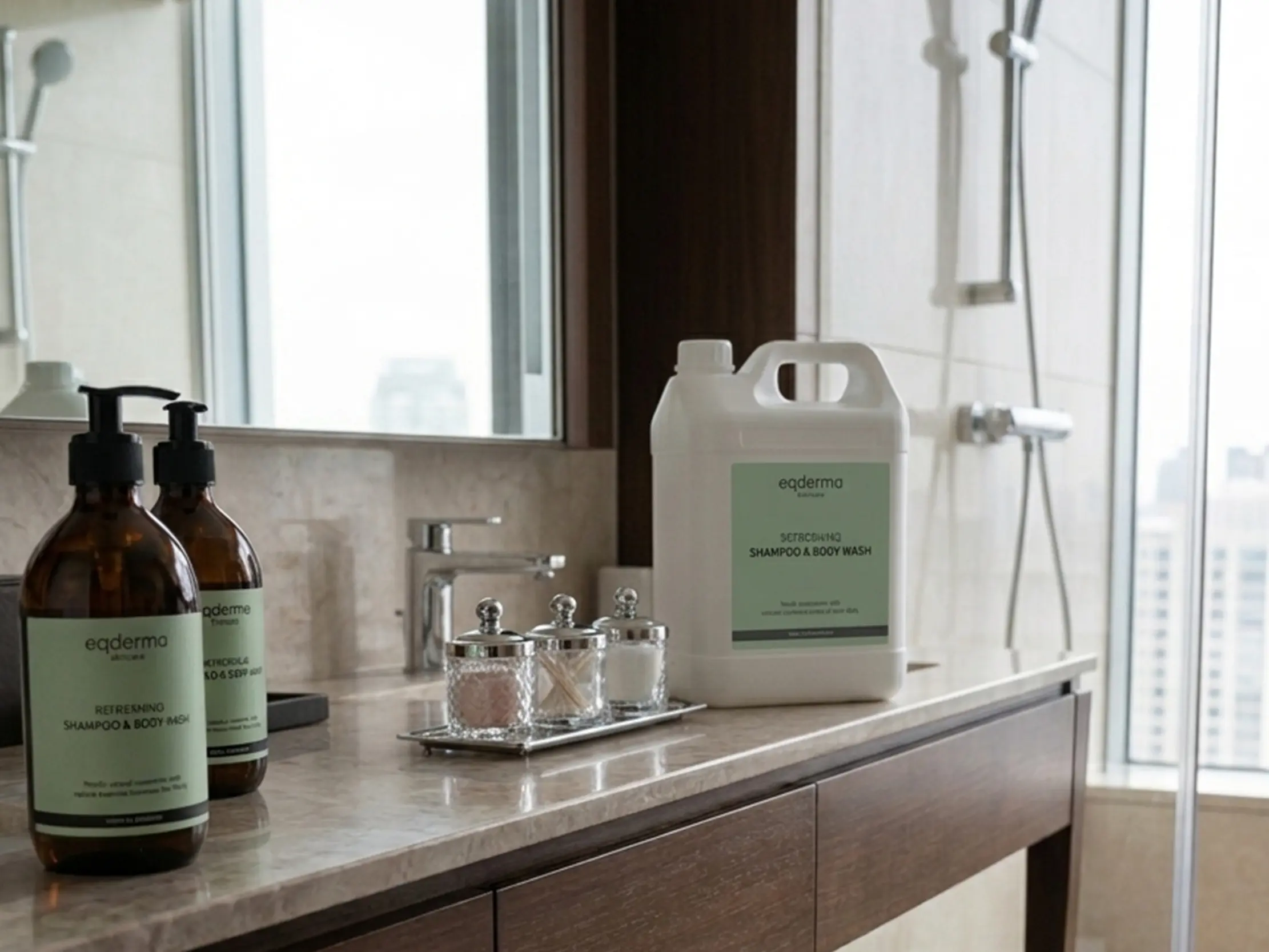
Today, managing Scope 3 (indirect greenhouse gas emissions) has become a priority. This ecological approach extends beyond footwear to your room cosmetics. For instance, swapping mini bottles for solid cosmetics like the Solido brand, or replacing non-refillable dispensers with cost-effective 5-liter bulk cans, actively reduces your carbon footprint.

Replacing fossil plastics with I'm Green technology allows you to instantly reduce your operations' carbon footprint, a massive asset for obtaining environmental labels (Green Key, Green Globe).

Conclusion: The Choice of Modern Profitability

Choosing sustainability is no longer a militant expense: it is a strategic, rational, and highly profitable financial arbitration. By moving to qualitative equipment, you reduce your TCO and transform a simple slipper into a brand ambassador.

Want to precisely calculate the ROI for your establishment?

Contact our Merveyl design office for a personalized audit of your room and spa amenities.

Share this content

0.0 0 votes
Please log in to rate this article

Add a comment

Loading...