Housekeeping: Equipping Your Rooms for Efficient Cleaning
Housekeeping, the Nerve Center of Hotel Profitability
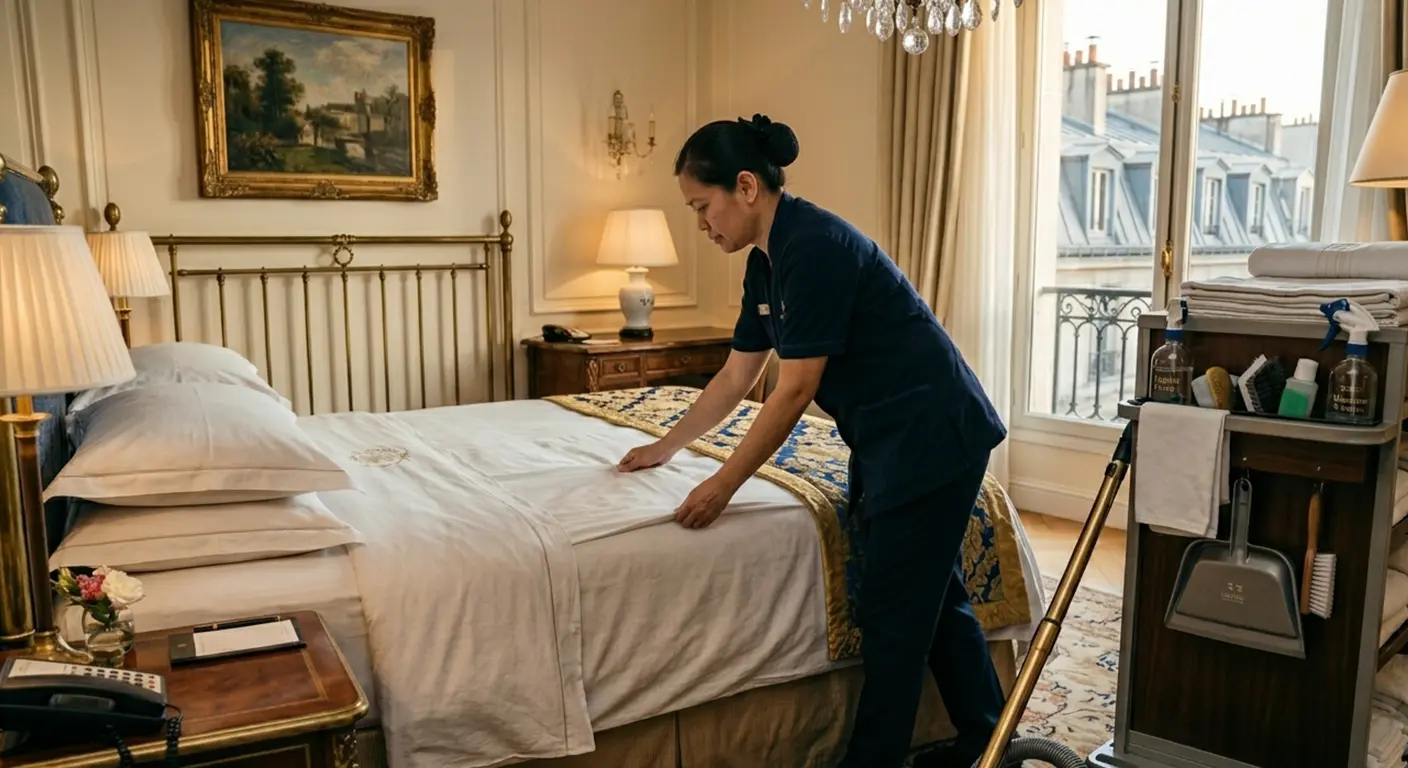
The operational reality is an unforgiving mathematical truth for any lodging director. The housekeeping department, led by the executive housekeeper, manages the largest operational expense of any hospitality establishment. It is also the department that carries the primary driver of guest satisfaction on its shoulders: cleanliness. It is eight o'clock in the morning. The daily briefing concludes, and the floor teams head into the corridors with their carts. In a highly competitive landscape, the presentation of the room must meet strict, exact standards from the very first second a guest crosses the threshold. A single smudge on a mirror or a misplaced sugar packet is enough to degrade the overall experience and generate a negative online review.
The modern challenge in hospitality lies in the rationalization of movements. Faced with a shortage of qualified personnel and the acceleration of guest turnovers, particularly in high-rotation properties, urban boutique hotels, or professional Airbnb concepts, rooms must be made spotless quickly, and with a precisely calculated workforce. The equation is straightforward: every single minute saved on cleaning a room, multiplied by the number of keys and by the days of operation, equals hundreds of labor hours saved annually. This time economy allows for the reduction of operational stress, prevents staff burnout, and reallocates time to qualitative finishing touches that matter to the guest.
The thesis we defend at Merveyl is built on years of field observation. Good room equipment is not merely an aesthetic element designed for website photography. It is, first and foremost, a working tool. It must be ergonomically designed to be handled, cleaned, and restocked in record time by the floor teams. As a distributor and partner of the historic British brand Corby of Windsor, we offer concrete hotel equipment solutions to blend the design expected by the guest with the operational efficiency demanded by management.
1. The "Coffee & Courtesy" Station: Saving Precious Minutes on the Welcome Tray
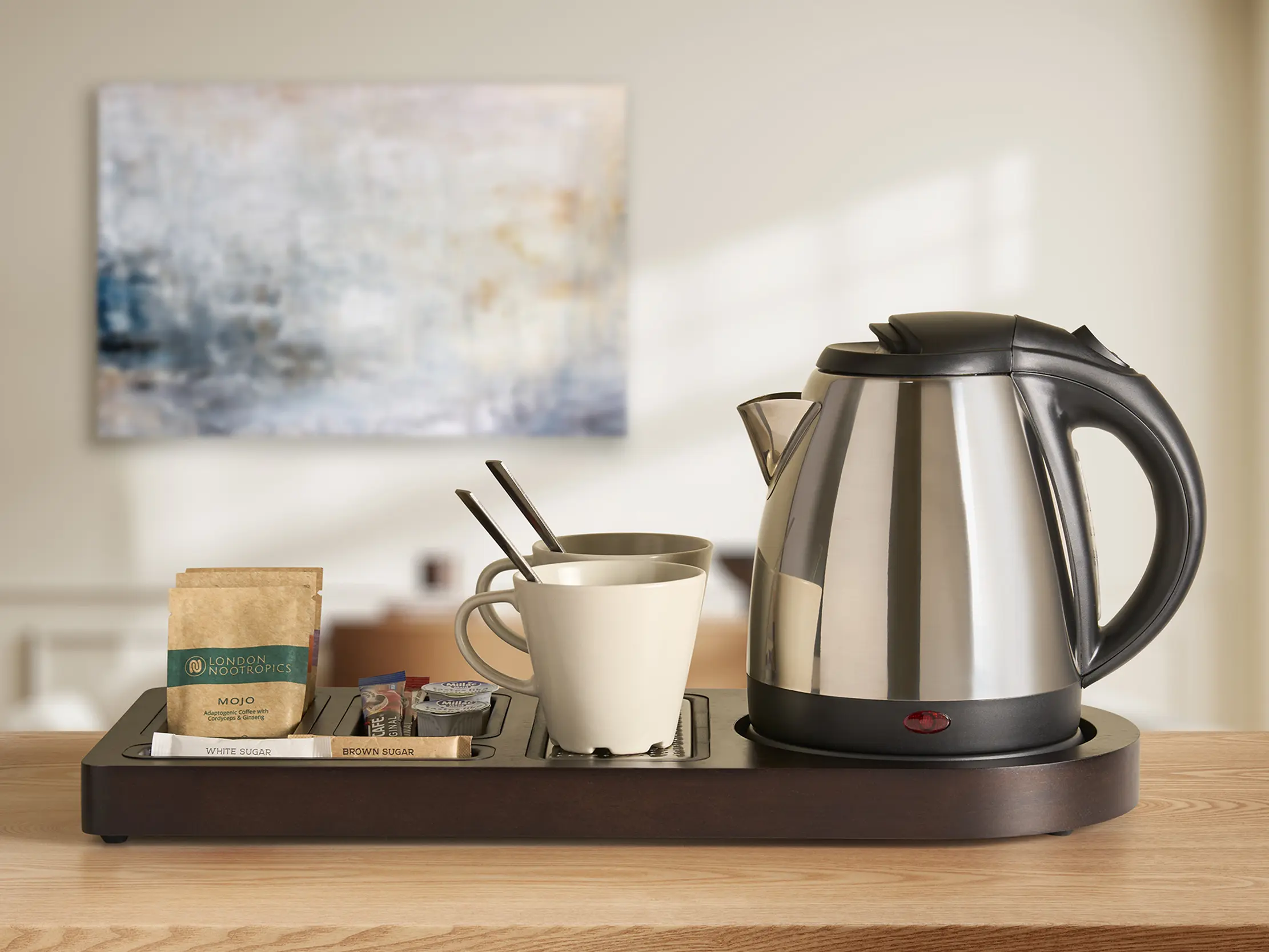
The Housekeeping struggle is very often concentrated on this specific point in the room. The area dedicated to hot beverages is notorious for being time-consuming during a stay-over or a full departure clean. Guests, often in a hurry, leave behind a disorganized zone. Sugar granules seep into furniture grooves, coffee spills stain surfaces, and torn, open sachets take considerable time to be sorted, counted, discarded, or realigned. A poorly conceived space quickly becomes an operational time sink.
The advantage of integrated welcome trays fundamentally modifies the room attendant's routine. Implementing compact trays featuring a recessed kettle base eliminates several unnecessary motions. Take, for example, the black Canterbury tray or the compact Aintree tray. On these models, the kettle is firmly secured to its base. The electrical cord is cleverly concealed. The staff member does not have to lift a loose base with one hand, wipe the desk with the other, and then untangle a cord that has fallen behind the furniture. A single sweep of a microfiber cloth over the entire block is enough to render the surface perfectly clean and dry. The materials selected by Merveyl, such as textured ABS or moisture-treated varnished wood found on the standard Buckingham model, possess hydrophobic properties. Liquids do not penetrate the material, preventing the appearance of persistent water rings that would require aggressive cleaning products and vigorous scrubbing.
Organization by compartments, utilizing dedicated sachet holders, provides a direct answer to in-room inventory management. The use of segmented organizers, like the Buxton bamboo sachet holder or the Ascot model, establishes immediate visual control. The compartments are precisely calibrated. The supervisor can identify in a fraction of a second, with a single glance from the doorway, if coffee pods or sugar sticks are missing. The days of wasting time rummaging through a bulk bowl to take inventory are over.
Housekeeping Welcome Amenities Comparison Table
2. The "Bathroom" Station: Impeccable Hygiene and Zero-Hassle Consumables
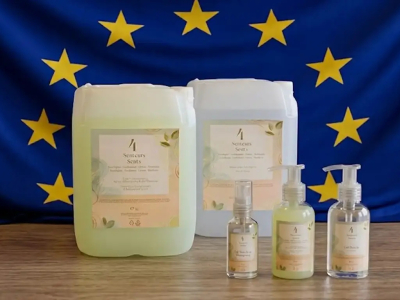
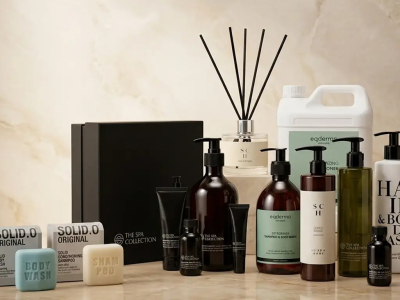
The ordeal of traditional plastic bottles and packaging is a recurring topic during hotel executive committee meetings. Mini-bottles of shower gel, shampoo, or body lotion present structural flaws for operations. They frequently leak, leaving sticky residue rings on marble or resin vanity tops, which demands deep cleaning. Furthermore, they require meticulous daily restocking to check fill levels, and they generate an astronomical volume of plastic waste that teams must evacuate.
The transition to bio-sourced Kraft box amenities transforms this approach. Merveyl offers courtesy accessories such as dental kits, shaving kits, or sewing kits, packaged in minimalist kraft cardboard boxes or kraft pouches. The operational benefit is massive: these geometric boxes remain perfectly stackable and structured on the counter. During the room cleaning sequence, if the box is visually intact and sealed, the attendant moves directly on to the next task. If it is torn or opened, it is replaced in two seconds with a single gesture. No drips, no sticky residue to scrub, no volume estimation required. The alternative of 5-liter bulk containers to refill pump dispensers or secured ecolabel bottles and care pouches follows this same logic of simplification and reduced handling.
Professional hotel hair dryers combine property security with optimized storage. The choice between a wall-mounted model, like the Kendal 1600W or the Dalton 1600W, and a mobile model depends on the room's layout. From a management perspective, wall-mounted units simply prevent theft, nullifying administrative replacement time, and guarantee a fixed place away from water sources. Mobile models, such as the Bedford 2000W foldable dryer, when stored in an embroidered fabric dryer bag, are protected from humidity and dust. Crucially, this pouch spares staff from having to tightly and tediously wrap the electrical cord around the handle, a common practice that eventually severs the device's internal wires. In terms of safety, the presence of an impulse switch on these ranges is a vital guarantee. The appliance cuts its heat as soon as the user releases pressure on the handle, eliminating the fire risk if a distracted guest places the running dryer on a bath towel while getting ready.
3. The "Wardrobe & Luggage" Station: Protecting Furniture and Streamlining Space
Luggage traffic causes significant material damage week after week. The guest often arrives exhausted from their journey. Their first reflex is to heavily drop their suitcase. If they are not guided by proper equipment, they throw their luggage on the floor or forcefully lean it against the walls, causing chipped paint or torn wallpaper that the technical department must repair, sometimes putting the room out of order.
Adopting luggage racks equipped with a protective backrest settles this issue. Merveyl luggage racks with backrests, whether it is the Ashton metal version or the classic York wooden model, create a rigid physical barrier between the suitcase frame and the room's wall. Furthermore, their cross-folding structure allows the floor team to lean them against the wall with one arm movement, clearing the floor for obstacle-free vacuuming, unlike fixed furniture. For tighter spaces, the backless Ashton luggage rack offers a compact alternative.
Absolute order in the wardrobe is the second pillar of the dressing area. The use of anti-theft hangers, whether it is the Clifford suit hanger, the Saltaire satin hanger, or the Burlington clip hanger, is a game changer. Beyond the financial impact linked to reduced theft, the closed-ring system with a security pin ensures that hangers remain permanently suspended on the rail. Teams no longer have to pick up tangled hangers at the bottom of the closet or forgotten ones on the top shelf. The alignment remains constant. The addition of functional accessories featuring hanging loops, such as the Skipton clothes brush or the Northampton shoehorn, assigns a dedicated place to each item, drastically simplifying the visual check during the final inspection.
4. The "Textiles & CSR" Station: Fewer Manipulations, More Ergonomics
The fight against Musculoskeletal Disorders (MSDs) is an absolute managerial priority. Hotel staff are highly exposed to injuries linked to repetitive motions, lower back bending, and load carrying. The arrangement of hotel equipment must respond to this occupational health imperative.
Abandoning thin plastics in favor of heavy fabric bags is a concrete measure. Replacing disposable packaging with Merveyl's reusable cotton laundry bags and shoe bags facilitates collection. The bags close with a simple pull on the drawstring, avoiding the need to tie a stubborn plastic knot. They are robust, do not tear under the critical weight of damp bath towels in the middle of the corridor, and fully integrate into the establishment's CSR (Corporate Social Responsibility) policy, a criterion increasingly scrutinized by corporate clientele.
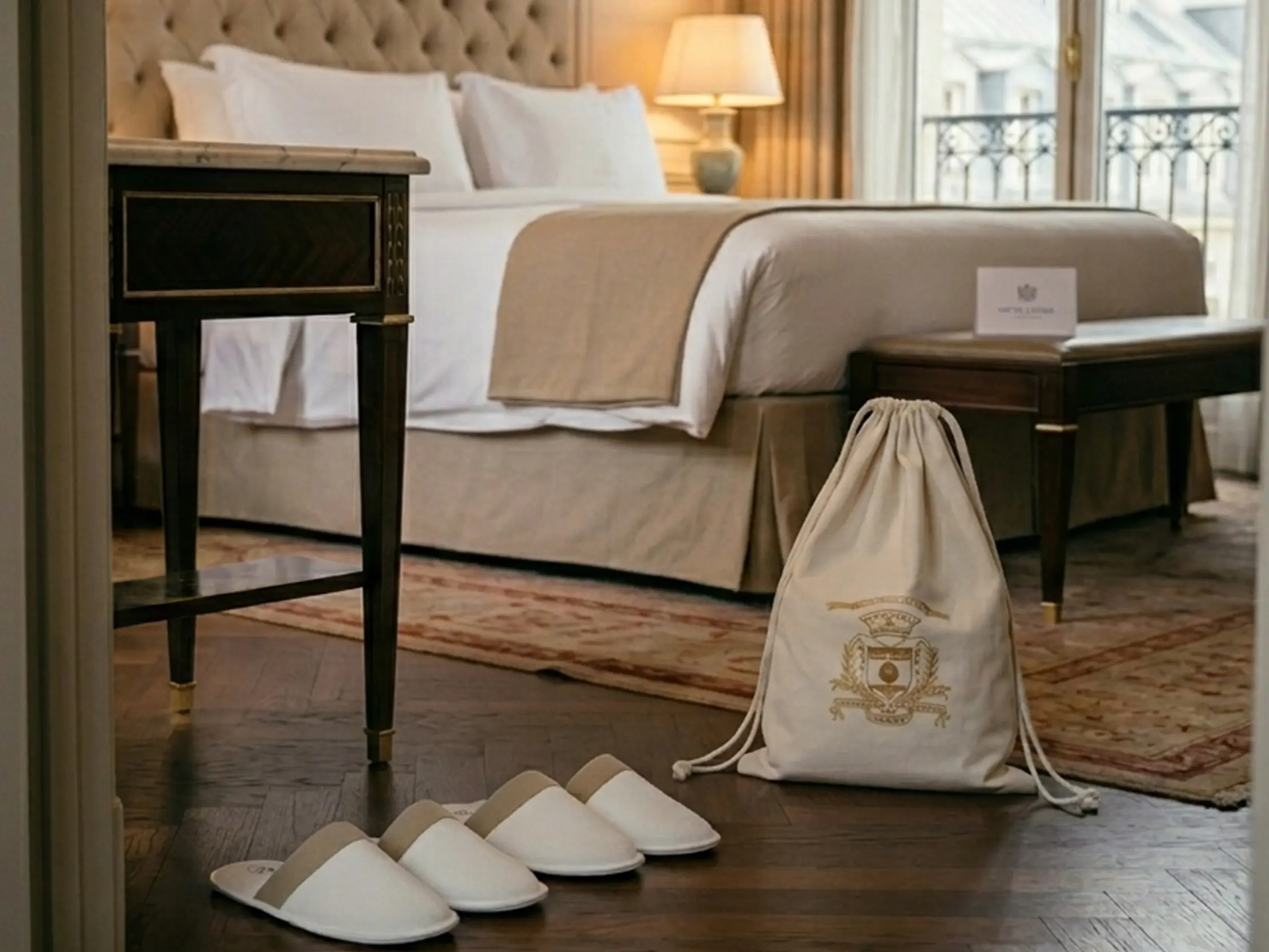
Regarding hotel slippers, the selection of which is strategic, positioning is facilitated. Delivered wrapped in a hygienic protective film, they do not get dirty during handling, are easy to stack and store on housekeeping cart shelves, and are placed with a precise gesture at the foot of the bed, guaranteeing the guest impeccable, certified hygiene before they even touch them.
5. Merveyl's "One-Minute Checklist" for Executive Housekeepers
To guarantee excellence and absolute adherence to hotel standards, the inspection must be methodical and visual. Here is the evaluation tool for an optimized room:
- The Courtesy Corner: Kettle tested and firmly anchored on its integrated tray. Power cord invisible from the entrance. The Buxton bamboo pod holder is restocked according to the strict planogram (e.g., 2 strong pods, 2 green teas, 4 brown sugars, 2 stirrers). The standard Epsom tray is free of water spots.
- The Wardrobe: Geometric alignment of anti-theft hangers facing the door opening, hooks all facing the same direction. Presence of the clean fabric laundry bag hanging on its hook. Wooden shoehorn visible and accessible without contortion.
- The Bathroom: Hairdryer tested, ventilation grille free of dust, and stored in its wall bracket or fabric pouch. Tissue box aligned. Kraft box amenities aligned symmetrically facing the mirror, logos oriented toward the guest. Solido dispenser cleaned without limescale traces.
6. FAQ: Questions from Housekeeping Professionals
The fastest and safest method is using a simple microfiber cloth very slightly dampened with clear water (or with a drop of neutral detergent). For Merveyl's varnished wooden trays, the application of aggressive chemicals, descalers, or abrasive sponges is prohibited and unnecessary, as the varnish already forms a complete water-repellent barrier.
The benefit goes beyond mere material savings. With a classic system, hangers are moved around by the guest. The room attendant must inspect the room to find them under a bed or on a chair, then note the missing ones, go back down to the pantry to fetch stock, and come back up to resupply the wardrobe. The anti-theft ring entirely eliminates this chain of unproductive actions.
The hotel textile bags distributed by Merveyl are crafted with a dense fabric weight and reinforced stitching. They are designed to withstand multiple high-temperature industrial cleaning cycles, including passing through a calendering machine. This type of product pays for itself quickly and eliminates the recurring expense line of single-use plastic bags.
Share this content